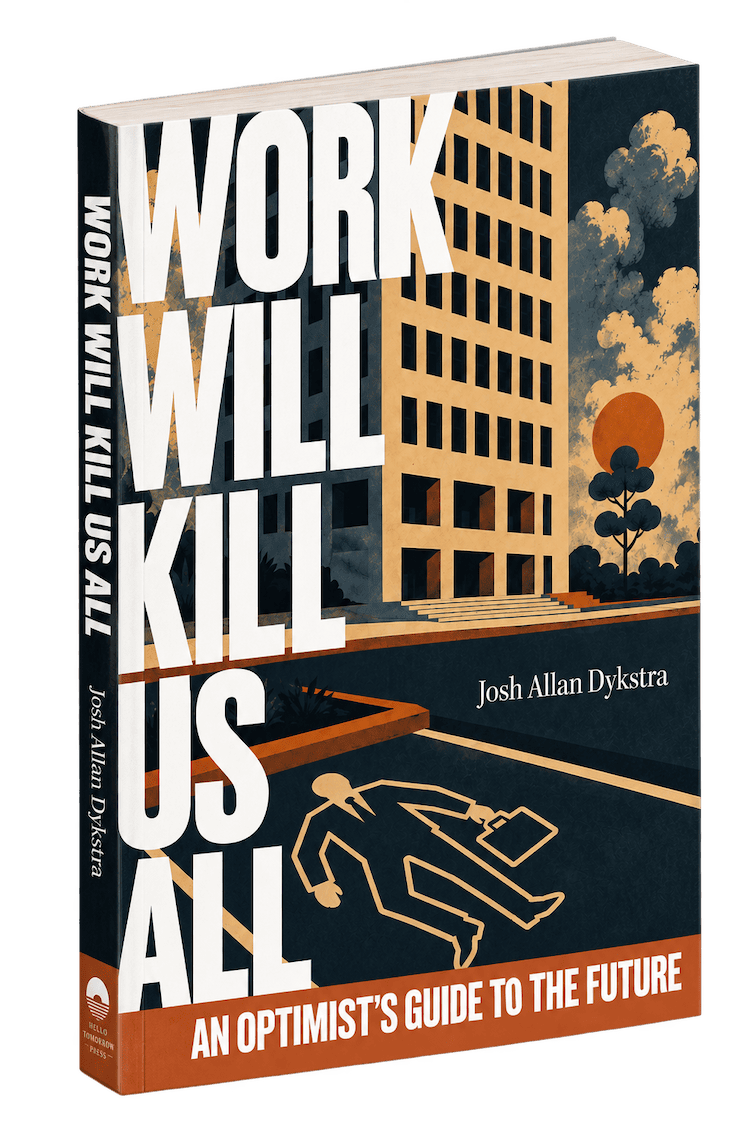
The future ought to be amazing.
We already have enough... we just haven't organized it right.
Our work could house, feed, and power the whole planet with a fraction of what we already produce.
So why don't we?
What if there's a simple, understandable reason behind all of this? What if the things that keep you awake at night aren't separate, impossible crises but problems we can solve together?
Early readers are fired up.
A.I. Anxiety. Layoffs. Burnout. Josh Allan Dykstra makes a compelling case that these aren't separate fires but symptoms of the same design flaw.
It’s rare an author can articulate both the root cause and eloquently describe what to do about it. Dykstra does both and manages to paint a hopeful view of the future along the way.
Every book about the future either sells you fear or sells you fantasy. This one does neither. It looks straight at what’s killing us and somehow leaves you more alive.
We are at the cliff’s edge. And the edge is starting to give way. Josh brings a compelling coherence to “How did we get here?”… and delivers a discerning hope that can transcend the limits we have created for ourselves.
This book gave me a completely different lens on why work feels the way it does right now, and what we could do instead.
In Work Will Kill Us All, JAD shows us how the future of work isn’t just about work, but about the future of everything.
“A nonstop parade of practical insights, delivered with the kind of poignant fury that can only come from someone who’s been beaten up in the arena for a couple decades fighting for work to not suck. JAD somehow makes systemic collapse feel less like doom and more like an invitation to a better future.”
“A.I. Anxiety. Layoffs. Burnout. Josh Allan Dykstra makes a compelling case that these aren't separate fires but symptoms of the same design flaw. Sharp, funny, and surprisingly hopeful, Work Will Kill Us All is the rare book about collapse that leaves you wanting to build something better.”
“I run a network of thousands of executives, and the exhaustion I hear from them isn’t just personal, but structural. Josh puts language to that in a way I haven’t seen before, and he’s not interested in just complaining about it. He wants to build something better, and he shows us how. This book gave me a completely different lens on why work feels the way it does right now, and what we could do instead.”
“Josh Allan Dykstra is that rare combination of pro-human, pro-AI, empathetic leader. This is a refreshingly raw and personal story and also a dire warning about the future we want and the consequences of getting distracted by a system that rewards fear. As Josh argues, we must intentionally create a society where all humans flourish. This is a brilliant, well-researched assessment of where we need to go from a great thinker and passionate advocate for responsible change.”
“Every book about the future either sells you fear or sells you fantasy. This one does neither. It looks straight at what’s killing us and somehow leaves you more alive. That takes guts, and Dykstra’s got them. Read this story before the robots write the ending.”
“Many books are being written about what ails us in this tumultuous time, but most obsess over the symptoms rather than give us a clear view of the true diagnosis. Moreover, it’s rare an author can articulate both the root cause and eloquently describe what to do about it. Dykstra does both and manages to paint a hopeful view of the future along the way.”
“In Work Will Kill Us All, JAD shows us how the future of work isn’t just about work, but about the future of everything.”
“Josh Allan Dykstra has written the kind of book that makes you stop and rethink assumptions you didn’t even realize you were making. Work Will Kill Us All is challenging, hopeful, and deeply human. It doesn’t just critique where we are, but asks us to imagine what work could become if we designed it around helping life flourish. This book will make you question some long-held assumptions about work and leadership, and leave you asking a better question: What are we actually trying to build?”
“A lot of books about the future of work claim to be important, but Josh Allan Dykstra's latest work actually delivers. The challenges we're facing are neither cosmetic nor conceptual. Work Will Kill Us All gives us a spotlight more than a prediction, preparing us for a ‘good fight’ that has been a century in the making.”
“We are at the cliff’s edge. And the edge is starting to give way. Josh brings a compelling coherence to “How did we get here?”… and delivers a discerning hope that can transcend the limits we have created for ourselves.”
“Most books about the future of work leave you either terrified or with a to-do list. Josh does something harder. He shows you the story we’ve all been running on without noticing, proves the chaos of the last twenty years is one problem and not fifty, and then puts something on the table I haven’t seen anywhere else: The Commons, a real third option beyond the market and the state, with the legal structure and funding model to actually build it. It’s profound, it’s new. Read it before your next strategy meeting.”
“In this thought provoking exploration of our relationship to work, JAD sheds light on the challenges so many of us have experienced through our career journey. In true optimist fashion, he also extends a solution and a bold invitation to a more beautiful world of work — and a more beautiful world for all of us.”
“This book is a balm for anxious souls. Once in a lifetime, a crisis culminates. Once in a lifetime, an opportunity emerges. Once in a lifetime, we can see the future and the past all at once. Once in a lifetime, a book arrives that helps make sense of it all. WWKUA is that book, and Josh Allan Dykstra is our guide. In four bracing acts, Josh explains why work sucks, points out the larger systems that force us to operate this way, and then paints a path for the way through. WWKUA is hyper-ambitious in scope, but, somehow exactly what we need for a moment in which what we do next will define many lifetimes in the future.”
“Josh argues that shared ownership is not a quaint holdover but the blueprint for what comes next, and he makes the case with enough research and humor that you keep reading even when the diagnosis stings. Read it if you are done with books that explain what is broken and ready for one that shows you where to start.”
“For more than twenty years, I've coached professionals who sensed something about work was ‘off’ but blamed themselves for it. In Work Will Kill Us All, Josh Allan Dykstra names what's really going on: the problem was never them. It's the story we've all been handed about what work is for. I've known Josh for a decade, and his boldness, honesty, and gift for getting to the root cause are all over these pages. This book doesn't stop at diagnosis. It invites us to build work, and a world, that’s worth being part of. Everyone who knows and feels the system we created is broken should read it.”
“I couldn’t put it down! Josh has put into words the feeling you have that things are not quite right. He affirms that you are not the problem, that the system we live in has an inherent pathology which turns humans into resources, work into suffering, and capital into something like a god. And he does this in a clear, crisp, and compelling style that keeps you reading through to the end — to the optimistic future we all want to believe in.”
“Thank you for writing such a BOLD, optimistic, and empowering book! Just as Audre Lorde famously said, ‘The master’s tools will never dismantle the master’s house,’ Josh Allan Dykstra challenges us to recognize the dangerous systems that open doors for only certain types of people and provides a collaborative strategy to tear it all down and rebuild using new tools and our imagination.”
“In this fascinating, well-researched, and intelligently presented book, Josh Allan Dykstra manages to illuminate our current path to destruction via capitalism while paving the way to economic and personal freedom for us all. He presents both sides of the coin as a choice we all must make if we want to survive and ultimately, thrive. If you value your economic future along with an essential and captivating read, I highly recommend this book.”
“Josh has long been a tireless warrior in the fight to make work not suck. In pausing to interrogate why it still does, his decades of deep study and hard-earned lessons culminate here in powerful, practical new ways to point our attention toward the defining existential crisis of our time — so we can get to tackling it together.”
“Josh has made positive provocation his habit, and his latest gift to the world brings it more than ever. As a B-Corp business owner, I align with Josh that a new way of organising work is needed that prioritises benefit for all and not just for the few. Let’s get to work and make change happen, together.”
“This is the book the world needs right now. I just finished reading it this morning and I feel fired up. This book should be required reading for anyone fed up with the status quo but not ready to give up on the future!”

Chapter 1
The story I’ve been trying to tell
I have been trying to tell you this story for twenty years.
I just didn’t know it.
In 2006 I moved, bright-eyed, to a little town called Los Angeles to be a rockstar. It didn’t work out, but that was ultimately for the best because I’m definitely not a “night person.” I then went back to school to get an MBA and find a job that would do remarkable things like, you know, pay my bills.
In 2012, I released a book called Igniting the Invisible Tribe: Designing an Organization That Doesn’t Suck. The thesis was simple: Organizations are mostly designed to suck but they don’t need to be, and when we design work around humans extraordinary things happen. I believed that then. I still believe it now.
What I didn’t understand — what would take me another fourteen years to learn, at considerable personal expense — is that the organizations were never really the problem.
The Story was.
The #lovework story
For the last two decades, I’ve described myself as a serial entrepreneur creating a bunch of different companies under one banner:
“Make work not suck.”
I almost certainly don’t need to convince you that work sucking is a real problem; you’ve very likely experienced it firsthand.
In 2018, I started building a tech company called #lovework. The question was: could a person actually learn how to enjoy work, just like we learn to play a sport or an instrument? And then, could we use technology to scale that learning process?
It was a simple, elegant, and achievable answer to a sprawling, global, deeply complex problem.
In the decade prior to #lovework, I had another obsession: flat, self-managing organizational structures. This might seem separate from the “loving work” question, but it is not. They are inseparable because humans crave autonomy and you don’t actually have that if you have a “boss.”
So, in building #lovework, we decided to do it differently. We would design our organization from scratch around the things that make work energizing. No hierarchy. No stupid rules. None of the typical workplace nonsense. Just real humans doing real work in ways that create more life than consume it.
And… it worked. The product did what we said it would do. Leaders wanted it. And everyone who worked at #lovework, I’m not kidding you, truly loved their work.
And then the container ate it.
An expensive seminar
#lovework wasn’t devoured dramatically. There was no single villain, no catastrophic moment. Just the slow, grinding reality that no matter how beautifully you design a product, the system we’re in only runs on one kind of fuel: profit.
In that system — which is what I mean when I say “the container” — profit is the thing that must, above all else, be protected.
#lovework wasn’t primarily defeated by a better competitor or a bad idea, but by the incentives of the system we were operating inside.
My friend Chuck calls these learning moments “seminars.” Apparently, I attended a very long, expensive one.
Here’s what the seminar taught me.
I spent almost twenty years trying to fix the system from inside the system. I was basically trying to make capitalism more humane… by participating in capitalism.
But this “container,” this Organizing Story, doesn’t just eat my last company.
It eats frickin’ everything.
The “Organizing Story”
So what, exactly, is an “Organizing Story”? And why does it matter so much?
Right now, humanity’s primary Organizing Story is “work.” Or “business.” Or “capitalism.” Pick the scale you prefer, because these are all manifestations of the same underlying Story.
- Work
- personal
- Business
- organizational
- Capitalism
- societal
This is the Story that almost every human life orbits.
It determines what gets built, what gets funded, who gets cared for, and who gets left behind — producing these outcomes we all experience, without ever seeing the Story underneath them.
Which means the only question that really matters is whether we can choose a different Story.
I believe we can. I believe we must.
In fact, I believe choosing a new Organizing Story is the most important thing humanity will do in the next century.
This book is my attempt to show you exactly what the last two decades have been teaching me.
The “work” story eats all the others
Work determines where you live. When you wake up. How much rest you get. Who you spend time with. How much future you’re able, or even allowed, to imagine. And if you’re in the U.S., it determines whether you get healthcare or not.
We talk about “work-life balance” as if work is one category among many in your life. It isn’t. Work eats all the other categories.
And here’s the really big problem. We handed “work” the job of “organizing life” and then let that system optimize everything…for profit.
That’s a system failure. Deming said, “A bad system will beat a good person every time.” I spent nearly two decades inadvertently trying to prove him wrong, but I couldn’t.
Warning: once you really, truly see this, you can’t unsee it.
You will start to notice how often leaders have to go against the system to do the right thing. How human-centered wins often require personal risk, repressed rebellion, or moral exhaustion. How the people trying hardest to “fix work” are often the ones burning out the fastest.
Becoming an optimistic futurist
Eventually, I hit that wall myself.
Years of pushing, persuading, and carrying risk finally collapsed me under their weight. Financially. Emotionally. Existentially. I had to face the same truth I was trying to help organizations avoid: we can’t keep servicing debt, human or financial, on the promise that things will magically improve later.
At the end of 2024, I was in serious trouble.
My company was dying; the thing I’d been building for almost a decade was on last-rites life support. I hadn’t officially pulled the plug, but the writing was on the wall and panic was in the air. I was starting to feel the losses scattering everywhere around me. I was on the brink of being company-less. Team-less. Career-less. Purpose-less.
The next six months of my life forced a reckoning, along with a big question. What if the problem wasn’t that I hadn’t tried hard enough, but that I was trying to fix the wrong thing?
Strangely, this dark, depressing time is also what turned me into an optimist.
Some people seem to be born optimists. They come into the world seeing rainbows and unicorns around every corner. I’m… not that guy.
I knew I was outgrowing the self-descriptions I’d used for twenty years, but I didn’t know what I was becoming. Nothing felt obvious to me. There were no flashing signs or deep booming voices or clear messages in my dreams. But when I got quiet, I found myself increasingly drawn to the word “futurist.” Eventually another word attached itself: “optimistic.”
“Optimistic Futurist.”
I decided to try it on. And as I wrote about it, I realized something important: you don’t have to be a “born optimist.” You can be a chosen optimist.
I decided I’d start practicing optimism through a new podcast called Hello Tomorrow. Deconstructing the state of the world every week in an optimistic way turned out to be really frickin’ difficult, as you might expect.
But the world needs optimism, especially when the future gets involved. Humans seem drawn to dark futures, so “dystopian hellhole” visions often live in our thoughts and memories rent-free. Terminators crushing skulls, Black Mirror nightmares, Mad Max cyberpunk grit… our imaginations are full of futures we don’t want.
I decided part of my new mission would be to conjure a vision of the future people would actually want to walk towards. Throughout the rest of this book, I’ll be inviting you to become a chosen optimist, too.
The Story & the system
This book is called Work Will Kill Us All, but I promise you it is not an attack on work. If anything, it’s a kind of “love letter” to meaningful work, and let’s say, a “pre-mortem” on the thing that harms most living things surrounding it, including good work. As we explore together, consider:
- Every civilization has an Organizing Story.
- That Story becomes encoded into an operating system.
- That operating system produces the outcomes we experience as everyday life, and our experiences reinforce the Story.
The Story and the system are mostly invisible, but you can see them, if you know where to look.
Let me show you.
That’s Chapter 1. The rest of the story is in the book.
Pre-order the book
Get your copy.
Pre-orders open soon. Get on the list and we'll let you know when it's ready to order!
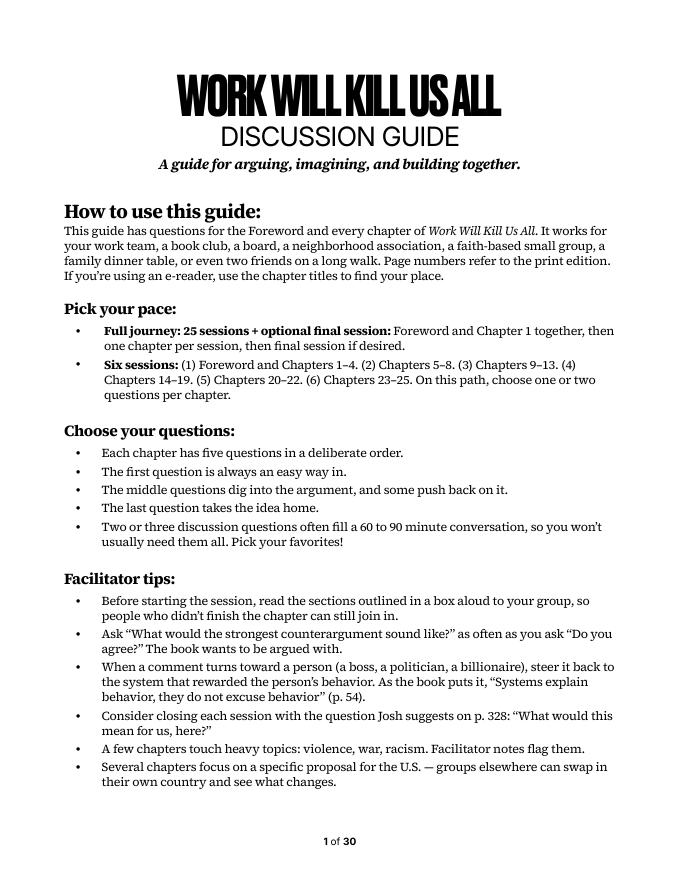
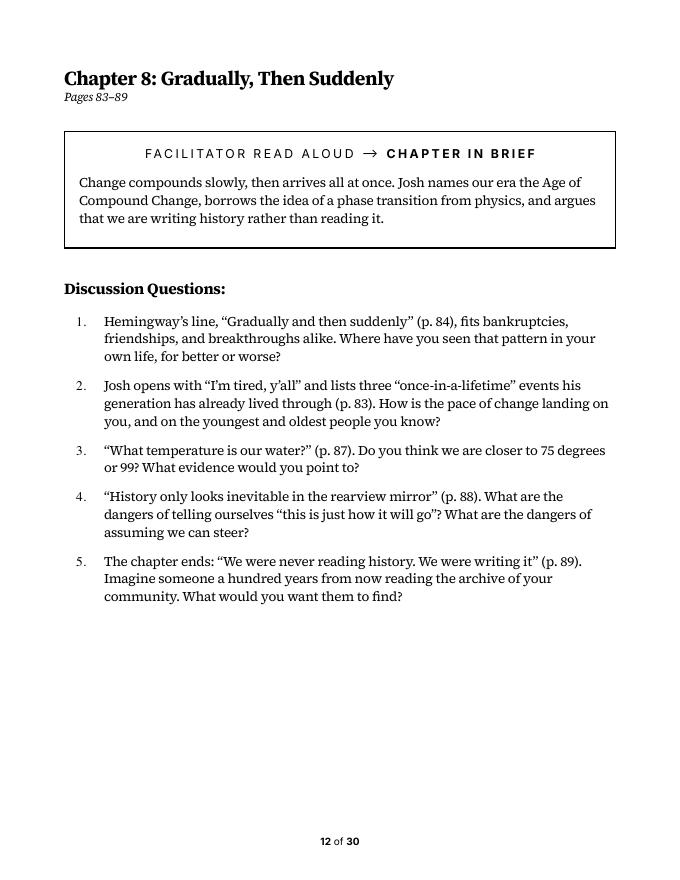
Free Discussion Guide
Better together.
Leading a discussion about WWKUA with your work team, book club, faith-based small group, or around your dinner table? The free Discussion Guide has powerful questions for every chapter, with read-aloud briefs and facilitator notes.
- 30 pages
- 130+ questions
- FREE to share

Josh Allan Dykstra
Josh spent twenty years helping organizations like Microsoft, Amazon, Genentech, and the State of Colorado build energizing workplaces. Along the way he discovered the real reason why work is so broken.
He's an optimistic futurist, keynote speaker, and host of the Hello Tomorrow podcast. More at joshallan.com.
Press & booking
Interviews, podcasts, keynotes, review copies. Josh would love to chat.
