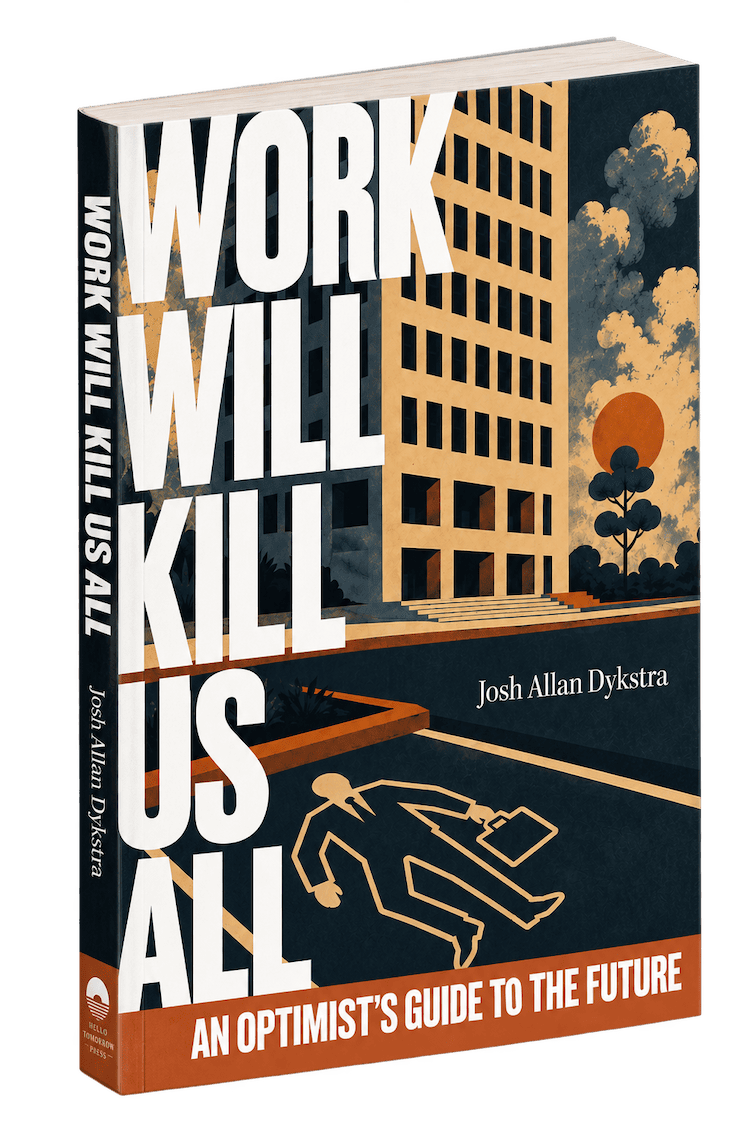
How to use this Guide#
This Guide has questions for the Foreword and every chapter of Work Will Kill Us All. It works for your work team, a book club, a board, a neighborhood association, a faith-based small group, a family dinner table, or even two friends on a long walk. Page numbers refer to the print edition. If you’re using an e-reader, use the chapter titles to find your place.
Pick your pace
- Full journey: 25 sessions + optional final session: Foreword and Chapter 1 together, then one chapter per session, then final session if desired.
- Six sessions: (1) Foreword and Chapters 1–4. (2) Chapters 5–8. (3) Chapters 9–13. (4) Chapters 14–19. (5) Chapters 20–22. (6) Chapters 23–25. On this path, choose one or two questions per chapter.
Choose your questions
- Each chapter has five questions in a deliberate order.
- The first question is always an easy way in.
- The middle questions dig into the argument, and some push back on it.
- The last question takes the idea home.
- Depending on group size, two or three discussion questions often fill a 60 to 90 minute conversation, so you won’t usually need them all. Pick your favorites!
Facilitator tips
- Before starting the session, read the sections outlined in a box aloud to your group, so people who didn’t finish the chapter can still join in.
- Ask “What would the strongest counterargument sound like?” as often as you ask “Do you agree?” The book wants to be argued with.
- When a comment turns toward a person (a boss, a politician, a billionaire), steer it back to the system that rewarded the person’s behavior. As the book puts it, “Systems explain behavior, they do not excuse behavior” (p. 54).
- Consider closing each session with the question Josh suggests on p. 328: “What would this mean for us, here?”
- A few chapters touch heavy topics: violence, war, racism. Facilitator notes flag them.
- Several chapters focus on a specific proposal for the U.S. — groups elsewhere can swap in their own country and see what changes.
What do we mean by “work”?#
Read this page aloud at your first session. It only takes a few minutes and will save you an hour of talking past each other.
Facilitator read aloud
Our society uses one four-letter word (“work,” of course) to describe at least three very different things (p. 61):
- Work = meaningless labor: activity that consumes human life without providing meaningful contribution.
- Work = meaningful work: “the deeply human act of building, caring, teaching, creating, repairing, discovering, contributing.” This includes unpaid work: raising children, tending a congregation, caring for a parent, volunteering, fixing the neighbor’s fence.
- Work = the Organizing Story: the economic system that decides which of the first two dominates our lives. It shows up at three scales: work (personal), business (organizational), and capitalism (societal) (pp. 3–4).
One of the book’s central claims is that people don’t hate work, they hate meaningless work, and the Organizing Story is what keeps producing work that sucks (p. 62).
Near the end, Josh adds: work is also “what we do with our energy, attention, imagination, resources, and one another to shape the world around us” (p. 311). That definition includes absolutely all of us. Whether you are employed, self-employed, between jobs, retired, a student, a caregiver, a volunteer, a pastor, or a founder, you are already part of this conversation about work.
Three terms to define with your group from the start. A full glossary is on p. 338.
Facilitator read aloud
- Organizing Story (p. 3): the dominant belief system a civilization uses to coordinate what gets funded, built, and valued.
- The container (p. 3): also referred to as the “system” — the structural architecture of laws, incentives, and cultural rules around any effort. It largely determines what that effort can become, whatever the quality of the people or ideas inside it.
- The Coin (pp. 53–54): two sides of reality. ME is individual choice and responsibility. WE is culture, incentives, and group norms. This book spends most of its time on WE without excusing ME.
Recommended ground rules#
These come from the book itself, which expects disagreement and plans for it.
Facilitator read aloud
- Skip the -isms. Josh doesn’t argue about capitalism, socialism, or communism, because “everyone’s holding a different dictionary” (p. 39). Avoid the -ism and ask: what kind of world do you want to live in?
- Systems explain behavior. They do not excuse it (p. 54). Critique the system AND keep people accountable. Hold both in the room. Remember that “most leaders are not monsters” (p. 18).
- Argue out loud. The Foreword invites readers to “argue, out loud, with what doesn’t sit right with you” (p. xi). Disagreement counts as participation.
- Speak from your own life. Use “I.” Nobody has to share more than they want to, and no story gets graded.
- Everyone’s work counts. Paid, unpaid, retired, between jobs, volunteer, caregiver. A pastor’s work, a caregiver’s work, a plumber’s work, and an executive’s work all belong in this conversation.
- Hold the hard parts and the hopeful parts together. The book defines optimism as “a decision made under duress, with full knowledge of the surrounding reality, to build anyway” (p. 180). Name the hard thing, then ask what could be built.
Short on time? Paths for different groups#
If you can only meet a few times, start with Chapter 1, then follow the path that fits your setting.
| Group type | Chapters | Why these? |
|---|---|---|
| Workplace teams | 2, 3, 6, 12, 22, 25 | Incentives, the cost of hiding who you are, meaningful work, ownership and A.I., self-managing organizations, taking action |
| Faith-based groups | 9, 14, 16, 17, 18, 25 | The story of a people asking for a king, creation stories, helping life flourish, endings and renewal, stewardship, serving the future |
| Neighborhood / civic groups | 7, 10, 20, 21, 23, 24 | Why systems resist reform, the middle class, community ownership, floors, funding, building from the edges |
| Families and friends | 5, 8, 15, 25 | Who decides what gets built, change that compounds, imagination, finding your edge |
Before you begin
The Foreword#
By Kali Love, pp. ix–xii
Facilitator read aloud Chapter in brief
Kali (Kah-lee) Love, a co-founder of the Hello Tomorrow Project and close collaborator with Josh who watched this book take shape, asks readers to notice how much of what feels “inevitable” is actually just familiar.
Discussion questions
- Kali asks you to imagine a child fifty years from now learning that humans “used to spend the majority of their lives working, just to be able to afford their basic needs” (p. ix). What would be the hardest part to explain to that child?
- “‘Normal’ is treating the rules we invented as if we didn’t invent them” (p. ix). Name something in your own life you have always treated as “just how it works” that people actually invented: a workweek, a retirement age, a résumé, a religious tradition, a family rule. Who invented it, and what problem were they solving?
- Kali asks you to take your time with one question: “What would the ideal future look like if you were the one building it?” (p. x). Give the group a minute of silence, then share one sentence each.
- The Foreword invites you to “walk the path between your heart and your mind” and to “argue, out loud, with what doesn’t sit right with you” (pp. x–xi). Where do you already expect to push back on this book?
- Take turns reading “The Future Can Hear Us” poem aloud, one stanza each (p. xii). Which line stays with you, and why?
Chapter 1
The Story I’ve Been Trying to Tell#
Pages 1–7
Facilitator read aloud Chapter in brief
After twenty years of trying to “make work not suck,” Josh concludes that the organizations were never the real problem. The Organizing Story around them was.
Discussion questions
- Think of the best work you have ever done, paid or unpaid. What made the difference: the people, the task, or the system around it? If that work ended, why? Did its ending have something to do with the system?
- Josh spent almost twenty years trying to “fix the system from inside the system” (p. 3). Have you ever tried to improve something from within a structure that kept pushing back? What happened, and what did you take from it?
- The chapter says work, business, and capitalism are one Story at three scales: personal, organizational, and societal (pp. 3–4). Where does that framing help you, and where does it feel like a stretch?
- “You don’t have to be a ‘born optimist.’ You can be a chosen optimist” (p. 6). Which are you: born, chosen, or still deciding? What would choosing it look like this month?
- Josh calls the book a “love letter” to meaningful work (p. 7). What are you hoping it will do for you, and what are you wary of?
Chapter 2
The Corporation Is a Sociopath#
Pages 11–19
Facilitator read aloud Chapter in brief
A thought experiment describes a being with no empathy, no conscience, and no long-term memory… and finds that description matches the modern corporation. Josh argues that harm at work often comes from system design and incentives, and no specific villain is required.
Note to facilitator: Many people carry real hurt from past workplaces. Let each person choose how deep to go.
Discussion questions
- The chapter opens by saying that if work has felt “insane” to you, it is probably because you are “quite sane” (p. 11). Have you ever blamed yourself for something the system caused? What changed when you saw it differently? Bonus: Did you notice the quote before the chapter began?
- Josh lists the euphemisms: layoffs become “right-sizing,” exhaustion becomes “high performance,” and surveillance becomes “productivity” (p. 14). What euphemisms do you hear in your workplace, school, congregation, or community that soften something hard?
- “You do not need a sociopathic person for a system to behave sociopathically” (p. 13). Do you agree that incentives shape behavior more than character does? Where might the argument be too tidy, and what would its strongest critic say?
- In “A Note About Leaders” (p. 18), Josh says many leaders are “trapped between their own values, the requirements of the organization (ahem, profit), and the silent threat of replacement.” If you have ever led anything (a team, a classroom, a household, a volunteer group), when did you feel that squeeze?
- When someone is overwhelmed, Josh writes, the system doesn’t ask “Is this workload humane?” It asks “Have you tried better time management?” or “Have you downloaded this meditation app?” (p. 17). Where have you seen a structural problem handed back to an individual as a personal one? When did that happen and what did it sound like?
Chapter 3
The Illusion of Separation#
Pages 21–28
Facilitator read aloud Chapter in brief
“Work-life balance” and “externalities” rest on the same belief: that we are separate from each other, from our systems, and from the living world. Josh argues that “separate” is a story, and that the story is what keeps harm invisible.
Note to facilitator: The chapter opens with two real acts of gun violence from September 2025. Give the group space to pause/reflect/respond if needed.
Discussion questions
- Josh defines “invisible violence” as harm “embedded so deeply in our societies, workplaces, economies, and governments that we barely register it” (p. 22). What form of violence have you gotten so used to that you stopped noticing?
- “You do not have a ‘work self’ and a ‘life self’ … You have a self.” (p. 24). Does that match your experience? When do you catch yourself putting on the “face” Josh describes as “performative separation” (p. 25)?
- Josh calls the hidden cost of making people leave parts of themselves at the door the “Dysregulation Tax” (p. 25). What does that tax cost your work team, family, or congregation? What is one practical thing your group could do to lower it?
- An externality is “someone else’s problem” (p. 27). Pick something cheap or convenient in your daily life: a product, an app, a delivery. Who pays the part that isn’t on the price tag? What would an honest price look like?
- Josh says the belief that we are separate is “the underlying mechanism that makes it invisible” (p. 23). Choose one problem that feels like it lives “out there” (poverty, pollution, the economy). If you stopped believing you were separate from it, what would you do differently?
Chapter 4
The -Isms Are Gonna Get Ya#
Pages 31–40
Facilitator read aloud Chapter in brief
Environmentalism centers the environment, humanism centers humans, and capitalism centers capital. Josh lays out four laws capital follows, separates “choice” from “freedom,” and offers a guideline for more productive dialogue: stop arguing about -isms.
Note to facilitator: This chapter is a test of the ground rules. Remind the group to skip the -ism and describe the world they want.
Discussion questions
- When you hear “capitalism” or “socialism,” what picture comes to mind first? Where did that picture come from: family, school, church, the news, your own experience?
- Josh uses “capitalism” functionally, to mean “the dominant operating system of our time: a system that organizes humanity around making more capital” (p. 34), and says it’s fine if you define it differently. Is his definition fair enough to work with? What would you change?
- The Four Laws of Capital: it must grow quickly and forever, be measured, be optimized, and be protected (pp. 34–36). Which law do you see most in your own workplace or community? Which feels most defensible, and which most dangerous?
- Using the example of a garment worker in Bangladesh, Josh argues that “choice is real, but choice is not the same thing as freedom” (p. 37). Does that weaken personal responsibility or complete it? Think of a time your own choices were limited by options you didn’t create.
- Try Josh’s rule: skip the -ism and ask, “What kind of world do we actually want to live in?” (p. 39). As a group, name three things you would want in that world. Where do your lists overlap?
Chapter 5
Who Do You Think You Work For?#
Pages 43–57
Facilitator read aloud Chapter in brief
Who decides what humanity spends its time building? Josh points to capital: the wealth pump, money as a claim on human labor, and a Story that makes it all feel like common sense. He also explains why John Maynard Keynes’s predicted fifteen-hour workweek never arrived.
Discussion questions
- Josh asks, “Who actually decides what humanity spends its time building?” (p. 43). How would you have answered before reading? Did the chapter change your answer? Consider his line: “Capital doesn’t build civilization, people do. But capital tells people what to build” (p. 47).
- In 1930, Keynes predicted a fifteen-hour workweek within a hundred years (2030!). He was right about rising living standards (p. 49) but very wrong about our work hours. If the gains made over the last century had been shared, what would you do with an extra twenty-five hours a week?
- Josh says the real divide is whether you make money from your labor or from your assets (p. 48). How does that line show up in your world? Share only what you’re comfortable sharing.
- The Coin has two sides, ME and WE. Josh says this book focuses on WE while insisting that “systems explain behavior, they do not excuse behavior” (p. 54). Is that balance right? Which side of the coin do you tend to focus on?
- “Why do I need a ‘boss’ at work when I don’t have a ‘boss’ anywhere else in my adult life?” (p. 56). What was your best (or worst) experience of being “managed”? What specifically made it great (or terrible)?
Chapter 6
Work Is Not the Problem#
Pages 59–70
Facilitator read aloud Chapter in brief
Five “witnesses” from very different worlds reach the same verdict: human beings thrive when their work matters (and so does business… but only over the long term). Josh separates three things we use the word “work” for and argues that the Organizing Story is what keeps producing the meaningless kind.
Discussion questions
- Describe a time you were so absorbed in something, paid or unpaid, that time disappeared. That is the “flow” Csikszentmihalyi studied (pp. 68–69). What conditions made it possible? BONUS POINTS: Does anyone know how to pronounce Csikszentmihalyi? (It’s Cheek-SENT-me-high-ee)
- Josh separates three meanings of “work”: meaningless labor, meaningful work, and the Organizing Story of work (p. 61). Which one fills most of your week right now, and which would you like more of?
- Graeber’s essay on “bullshit jobs” estimated that 30 to 40 percent of British workers felt their jobs didn’t need to exist. Even the skeptical follow-up study found almost one in five (p. 60). Do you think pointless-feeling work is common in your industry/occupation? Which industries/occupations do you see it in?
- The five witnesses are Graeber, the “lying flat” blogger, McKinsey, Gallup, and the Firms of Endearment (pp. 59–66). Which testimony convinced you most? Which would you cross-examine further?
- “The real prescription is less waste, not less work” (p. 69). What is one recurring task or meeting in your life that is waste? What meaningful thing could take its place?
Chapter 7
The System Can’t Fix Itself#
Pages 73–81
Facilitator read aloud Chapter in brief
In 1787, a French finance minister correctly diagnosed his country’s crisis, and the people with the power to fix it refused… and were then executed during the following revolution. Josh argues that we are in a similar room today. He also explains why systems keep selecting the people who keep them going.
Discussion questions
- The 144 men in Calonne’s room heard the case for reform and did nothing (pp. 73– 74). Have you ever watched a group acknowledge a problem, write a report, and change nothing? Why does that happen?
- Josh says A.I. leaders who warn about job losses aren’t hypocrites: “Their position forecloses the action” (p. 76). Is that persuasive, generous, or too forgiving? Is there a difference between being unable to act and being unwilling?
- “Position papers do not dismantle the architectures that fund them” (p. 78). Where have you seen “something is being done” stand in for doing something: in politics, business, a congregation, a community?
- Elections and corporate hierarchies are “selecting for whatever traits the system rewards” (p. 79). Josh points to Athens, Ireland’s citizens’ assembly, and Taiwan’s vTaiwan as alternatives (pp. 79–80). Would you trust a randomly selected group of ordinary people to decide a hard question? What would you need to see first?
- Josh concludes, “Our work is construction” (p. 81), meaning building the next thing rather than reforming the old one. Is there something in your sphere of influence that needs building rather than fixing? What would the first “brick” be?
Chapter 8
Gradually, Then Suddenly#
Pages 83–89
Facilitator read aloud Chapter in brief
Change often compounds slowly, then arrives all at once. Josh names our era the Age of Compound Change, borrows the idea of a phase transition from physics, and argues that we are writing history rather than reading it.
Discussion questions
- Hemingway’s line, “Gradually and then suddenly” (p. 84), fits bankruptcies, friendships, and breakthroughs alike. Where have you seen that pattern in your own life, for better or worse?
- Josh opens with “I’m tired, y’all” and lists three “once-in-a-lifetime” events his generation has already lived through (p. 83). How is the pace of change landing on you? How do you see it landing on the youngest and oldest people you know?
- “What temperature is our water?” (p. 87). Do you think we are closer to 75 degrees or 99? What evidence would you point to?
- “History only looks inevitable in the rearview mirror” (p. 88). What are the dangers of telling ourselves “this is just how it will go”? What are the dangers of assuming we can steer?
- The chapter ends: “We were never reading history. We were writing it” (p. 89). Imagine someone a hundred years from now reading about the life of your community. What would you want them to read?
Chapter 9
Civilization’s Cycle of Death#
Pages 93–106
Facilitator read aloud Chapter in brief
For about 288,000 of humanity’s 300,000 years, societies actively prevented anyone from hoarding power. Surplus changed that, and started what Josh calls the Cycle of Death: power concentrates, pressure builds, something breaks, and the system resets.
Note to facilitator: This chapter covers war, civilian deaths, and the biblical story of Israel asking for a king (1 Samuel, pp. 97–98). Faith-based groups may want extra time.
Discussion questions
- In 1 Samuel, the people ask for a king right after Samuel lists exactly what a king will take (pp. 97–98). Josh says the Cycle “isn’t really a story about power, but a story about us” (p. 98). When have you, or a group you belong to, traded away freedom for the relief of having someone else in charge?
- For most of human history, groups worked together to keep anyone from gaining power over the rest (p. 95). Does that change how you think about hierarchy as “human nature”?
- Josh suspects the egalitarian Story survived in some societies because of scarcity rather than wisdom: “The better Story was preserved by scarcity” (p. 105). Is that discouraging or clarifying? If any group that gets rich enough starts to hoard, what do you think could stop it?
- He admits to compressing 12,000 years of history into about seven pages (p. 101). Did anything seem oversimplified or missing to you? Does the big pattern hold up anyway?
- In the opening story, a hunter who brags about his kill would get ridiculed or exiled (pp. 93–94). In many ways, bragging is still largely looked down upon and sharing is still largely seen as virtuous… so why do we allow some people to brag about and hoard so much wealth today?
Chapter 10
The Happy Accident of the Middle Class#
Pages 109–118
Facilitator read aloud Chapter in brief
The U.S. middle class came from an accident (U.S. factories were the only ones left standing after World War II) plus a set of choices (a 91% top tax rate, the GI Bill, strong unions). Josh calls it a forty-year pause in a much older pattern.
Note to facilitator: This chapter discusses racial exclusion from the GI Bill and federal housing programs, and opens with a 1933 plot to overthrow FDR. Invite personal stories gently.
Discussion questions
- What does “normal” look like in your imagination: one income, a paid-off house, a pension (pp. 110–111)? How does your family’s story compare with that picture?
- Josh separates “the part that was an accident” (postwar industrial dominance) from “the part we did on purpose” (taxes, the GI Bill, unions) (pp. 112–114). Which part matters more for what we do next, and why?
- In “Who Got Left Out” (pp. 114–115), Josh shows how GI Bill benefits largely bypassed Black veterans, and says any rebuilt version “needs to actually be accessible to everyone.” What does it take for a program to be for everyone in practice, and not only on paper?
- He argues that the middle class was an “oddity” and that it “was designed” (p. 117). How does that change your relationship to nostalgia for “the way things used to be”? Is nostalgia for the middle class useful, a trap, or both?
- “We stopped fighting to protect what had been won” (p. 117). What did your community, workplace, or family win through hard effort that younger people now take for granted? What would it take to protect it again?
Chapter 11
Work Will Kill Us All#
Pages 121–133
Facilitator read aloud Chapter in brief
Five “patient scans” (planetary boundaries, dirty energy, extreme wealth, human suffering, and war) lead to one diagnosis: a single disease that leads back to the way we approach work. The chapter also holds the book’s clearest proof that people can fix a global problem: the ozone layer.
Note to facilitator: This is the heaviest chapter. It covers climate breakdown, loneliness, and war. Save time at the end for the ozone story (pp. 122–123, 130), which Josh offers as a reason for hope.
Discussion questions
- Which of the five scans hit you the hardest: planetary boundaries, dirty energy, concentrated wealth, human suffering, or war? Why that one?
- Humanity has repaired exactly one planetary boundary, the ozone layer, when 197 countries “looked at the data, coordinated, and changed course” (p. 130). Why do you think that worked? What would have to be true for it to happen again?
- Josh calls the five scans “one disease, showing up in five infected systems” (p. 131) and says ecological collapse is “the floor the other four are standing on” (p. 132). Which connections convinced you, and which didn’t?
- “Curbing your plastic straw usage isn’t going to cut it” (p. 126). If personal choices aren’t enough, what is the right role for individual action?
- After a chapter this heavy, what are you carrying out of the room? Name it in a word, then share something you need from this group (or from someone else) that would help you keep going.
Chapter 12
Who Owns the Robots?#
Pages 135–146
Facilitator read aloud Chapter in brief
The framing question from Josh’s most-watched podcast episode, “Who Buys Your Stuff, Robots?” turned out to sit on top of a much older question: Who owns the robots? He argues that ownership, not technology, decides who benefits from every new surplus, and this will include whatever gains A.I. brings… unless our Story changes.
Discussion questions
- What is your honest first reaction to A.I. right now: excitement, worry, indifference, or a mix? What has shaped it: a job, a child, a headline, a tool you use?
- “New technologies are remarkably good at creating new wealth. They’re remarkably bad at deciding who gets to own that wealth” (p. 137). Test that against one example from the chapter: agriculture, factories, or the internet. Does it hold?
- How does Josh’s reading of the Luddites, as “skilled craftsmen making an argument about who controlled their future” (p. 138), change your picture of them?
- Josh argues that abundance feeds concentration: “Abundance is the thing that feeds it” (p. 140). The “age of abundance” camp says the opposite. Which is more likely to be shared in practice? What evidence would change your mind?
- For most of history, “labor was how most people participated in a world they did not own,” and A.I. may collapse that bridge (p. 144). If the bridge narrows, what do you most want in place for your community, your congregation, or your children?
Chapter 13
The Storm#
Pages 149–154
Facilitator read aloud Chapter in brief
Abigail and John Adams lived two very different versions of the same turning point. Josh calls transitional times like these The Storm: the stretch of time when today’s Organizing Story loses its grip on tomorrow’s reality and the rules of civilization become editable.
Discussion questions
- In July 1776, John signed his name to a revolution while Abigail inoculated their children against smallpox (pp. 149–151). Both were right about what they were living through. Which one do you feel more like these days: the signer, or the one tending the fever chart?
- Josh says our times are “very precedented” rather than unprecedented (p. 150). Does that comfort you, worry you, or make you skeptical?
- He leans on Strauss and Howe’s pattern of upheaval roughly every eighty to one hundred years, and on Peter Turchin’s “End Times,” while admitting that no single framework is “the” answer (p. 153). How much weight do you give big-pattern theories like these? Does it feel like The Storm to you, right now?
- “Storms clear the ground for possibilities that simply can’t exist during calmer seasons” (p. 154). Is it right to find hope in a crisis while people are suffering? How do you hold both?
- If the rules really are editable right now, which one rule in your own sphere would you most like to rewrite: a workplace policy, a government policy, a family tradition, a community norm?
Chapter 14
The Epic Tale of All of Us#
Pages 159–167
Facilitator read aloud Chapter in brief
George Lucas built Star Wars on Joseph Campbell’s hero’s journey. Josh argues that centering the lone hero both reflects and teaches hierarchy, and offers older, ensemble stories (Skywoman Falling and Ursula Le Guin’s carrier bag) as alternative templates for understanding what comes next.
Discussion questions
- Who is the “hero” of one of your favorite stories (a film, a book, or your own life)? Now name the people standing behind that hero (helpers, mentors, family) who never make the poster.
- Josh says the individual hero story “doesn’t just reflect hierarchy, it teaches hierarchy” (p. 162). Do you buy that? How have the stories you grew up with (movies, scripture, biographies) shaped what you expect from leaders?
- Compare Genesis, where agency flows down from one source, with Skywoman Falling, where “agency flows among” a community of beings (pp. 164–165). You don’t have to choose between them. What does each story assume about who holds power and who holds responsibility?
- The Civil Rights Movement is often told as Dr. King’s story, yet Josh says “King was extraordinarily important, he just wasn’t the whole story” (p. 166). What other popular “social change” stories can you think of, and do they mostly feature one prominent individual?
- “A spear tells you who ‘won,’ but a bag tells you who got to eat” (p. 166). Where could your group, team, or household shift from spear thinking to carrier-bag thinking? Josh’s version of the question is, “Here’s the container; what can each of us bring?” (p. 167). What can you bring?
Chapter 15
Imagination Is Not Optional#
Pages 169–182
Facilitator read aloud Chapter in brief
Chicago’s 1893 White City world’s fair and Hull House a few miles away show a civilization imagining itself and confronting itself at the same time. Josh argues that collective imagination is a prerequisite for positive change, and that most things we now call “normal” began as someone’s imagined idea.
Discussion questions
- Have you ever stood inside a vision of the future that moved you: a world’s fair, a museum, a film, a city, a worship service? What did it do to you?
- “The glorious and the grotesque don’t take turns” (p. 171). The White City dazzled millions while excluding many, and Hull House critiqued it by simply existing. Why does Josh insist on holding both? What is the risk of seeing only one? Which are you more prone to?
- Josh notes that we can imagine A.I. doing enormous amounts of human work, but if we ask for a society where survival doesn’t depend on selling your labor then “everybody gets very nervous about what’s ‘realistic’” (pp. 176–177). Is that an imagination problem, or are there real constraints? What would you need to believe to take the leap?
- He lists ideas that were once called crazy: public schools, national parks, the weekend, Social Security, public libraries, the internet (p. 178). Pick one and Google “who argued against it.” What did they say? What does that suggest about today’s “impossible” ideas?
- Josh defines optimism as “a decision made under duress, with full knowledge of the surrounding reality, to build anyway” (p. 180). Pick one of his “what if” questions on p. 181 and finish this sentence together: “In twenty years I’d love to live in a world where…”
Chapter 16
Help Life Flourish#
Pages 185–193
Facilitator read aloud Chapter in brief
Forest ecologist Suzanne Simard found trees trading nutrients underground, and a dying tree passing about 40% of its carbon to its neighbors. With that as inspiration, Josh proposes a new Organizing Story: “Help life flourish,” along with a one-question “Flourishing Test.”
Discussion questions
- In Simard’s forest, “mother trees” feed seedlings too small to feed themselves (pp. 185–186). Who has been a “mother tree” in your life or community?
- Josh chose each word of his new Story proposal deliberately. “Help” is a verb that implies you’re not the main character. “Life” includes more than humans. “Flourish” has an “enough” built in (pp. 188–191). Which word matters most to you? Would you have chosen any different ones?
- “In the old Story, flourishing is valuable only when it produces ‘more.’ In the new Story, ‘more’ is only valuable if it produces flourishing” (p. 191). Think of an organization you know: your employer, school, church, or a charity. In which direction does it actually run? Toward producing more? Or producing more life?
- The Flourishing Test asks: “Does this help life flourish, or does it require life to serve capital?” (p. 192). Josh admits it won’t always have an easy answer. Try it on something real and contested in your community: a development, a policy, a budget. Where does the test help, and where does it strain?
- Josh says we invented economies and corporations and then started behaving as though we exist to serve them (pp. 187–188). Where do you hear “the job requires it,” “the market requires it,” or “the economy requires it”? Who or what is actually being served?
Chapter 17
Everything Dies (Because It Should)#
Pages 195–205
Facilitator read aloud Chapter in brief
Gardens die every autumn, and it’s time for some of our old structures to die, too. Josh uses entropy, apoptosis, and an old idea of money that loses value when it sits still to argue that the goal is saving people, not every decaying job.
Discussion questions
- Josh asks why we accept autumn in a garden but panic when a company, industry, or institution ends (pp. 195–196). What is the last ending you resisted: a business, a tradition, a church program, a relationship? Looking back, what grew after the ending?
- “Death is one of the tools life uses to survive” (p. 197), as in apoptosis, where healthy cells self-destruct and a cell that refuses becomes cancer. Where does that metaphor illuminate something for you, and where does it feel too neat?
- “We keep asking, ‘How do we save the jobs?’ The better question is, ‘How do we save the people, while letting the decaying jobs die?’” (p. 203). Who in your community has lived through the death of an industry or employer? What would “saving the people” have required?
- Capital is designed to accumulate indefinitely, unlike anything else in nature, and then “we spend finite human energy maintaining its immortality” (pp. 200–201). This section contains the only f-bomb in the whole book. Why do you think Josh used that language here and nowhere else?
- Silvio Gesell proposed money that loses a little value if it sits still (pp. 201–202). Would this work? What in your own life or organization is “sitting” (money, time, space, a building, know-how) that could circulate?
Chapter 18
Regenerative [Everything]#
Pages 207–216
Facilitator read aloud Chapter in brief
Money that stops circulating functions like a blood clot. Josh recommends separating surplus (what a healthy system circulates) from profit (surplus captured and held), turns to biomimicry for design principles, and describes a summer night in Denver ruined by wildfire smoke.
Discussion questions
- Josh writes about a summer evening in his Denver yard cut short by wildfire smoke, “a harbinger of the future none of us want” (pp. 215–216). Where have you experienced a small personal taste of that: wildfire smoke, a flood, a too-hot summer, a favorite place changed by a shifting climate?
- Josh says wealth that doesn’t circulate acts like a blood clot (pp. 208–210) that harms the larger body. Does the metaphor help or oversimplify? What would healthy circulation look like for money in your community?
- “Surplus is what a healthy system produces and circulates. Profit is what happens when someone captures that surplus and stops it from circulating” (p. 212). Test that on a business or institution you admire. Is it circulating surplus or capturing profit? How can you tell?
- Bill Gates gave his foundation an end date of 2045, which Josh describes as giving it an “apoptosis mechanism” (p. 210). Should large charitable institutions be required to spend down and close? Are there good arguments for permanence?
- Janine Benyus’s biomimicry treats nature as model, measure, and mentor (p. 214). Replace “What can we get out of this?” with “What does this system need from us so it can keep flourishing?” Pick a place (a yard, a team, a neighborhood) and ask the second question. What’s the answer?
Chapter 19
America First#
Pages 219–227
Facilitator read aloud Chapter in brief
Even if national leaders see that the old Story’s “greed is good” game is destructive, they can’t quit. Josh argues the U.S. must go first. He then introduces the idea behind The Commons: the things your life depends on should belong to you and your community.
Note to facilitator: This chapter is written for the U.S. (“This proposal is designed for the United States,” p. 224). Members in other countries can discuss how it translates to theirs.
Discussion questions
- Readers tell Josh, “Bro, just move to Denmark.” Why doesn’t he (pp. 222–223)? What do you love enough about your country, city, or community to stay and try to change it? Where do you feel the opposite?
- In a lock-in, everyone knows the game is destructive, and “nobody can stop playing it alone” (p. 220). Where have you seen that in a smaller setting: a price war, a school “arms race,” a workplace where everyone stays late? Have you ever seen a group break this trap successfully?
- Josh argues the U.S. should go first because it is powerful enough to change what the game is (pp. 220–221). Is that wise, naive, arrogant, or all three? What would a prestige metric for helping life flourish look like?
- “Holding competing ideas in tension, it turns out, is exactly what optimism requires of us” (p. 223). Is it hard to love and criticize the same country, church, company, or family at once? Where have you done both?
- “You. Should. Own. This.” (p. 225). Josh says Americans don’t want to be “taken care of,” they want to own their future. Does that match the people around you? How do you think your neighbors, coworkers, or congregation would react to this pitch?
Chapter 20
The Missing Third Option#
Pages 231–246
Facilitator read aloud Chapter in brief
The Mondragon cooperatives in Spain show that community ownership works as a third option beyond public and private. Josh traces how the commons were enclosed, shows how Elinor Ostrom disproved the “tragedy of the commons,” and proposes two parallel economies: The Commons for what we need and The Market for what we want.
Discussion questions
- Before this chapter, had you thought of “public versus private” as the only choices? Where have you seen shared ownership up close, such as a co-op, credit union, or land trust? When The Commons came up, which label did your brain reach for: “socialism,” “Scandinavia,” or “Government 2.0” (p. 245)?
- At Mondragon, the highest-paid worker earns no more than six times the lowest-paid (p. 232). The average U.S. CEO earns 285 times the average worker. What do you make of a pay cap? Would you want to work somewhere like Mondragon?
- Josh describes enclosure: shared land fenced off, so landless people suddenly “needed wages to survive” (pp. 234–235). Does that origin story change how you see wage work? What “fences” have you watched go up in your lifetime?
- Ostrom studied more than 800 real commons. Josh’s takeaway: the real question is how to “design our sharing well” (p. 241). Think of a shared resource in your life, such as a park, a shared drive, or a church kitchen. What made it work or fail?
- The mantra: “If something is required for life, it should not be for profit” (p. 242). From Josh’s starting list (pp. 242–243), which would you want to see worked on first, and which gives you pause?
Chapter 21
A New Kind of Floor#
Pages 249–259
Facilitator read aloud Chapter in brief
From Hammurabi’s law to the building codes of today, societies have always drawn floors below which nobody can fall. Josh proposes The Commons as a floor and not a ceiling, with eight starting sectors, a floor defined locally, and a promise to keep upgrading it.
Note to facilitator: The Triangle Shirtwaist fire (pp. 250–251) is described in some detail. 146 workers died in a brutal fire. Handle with care.
Discussion questions
- Name a floor you take for granted: a building code, seat belts, food safety, the weekend. What would life be like without it? Do you know who fought for it and for how long?
- “Every single one of these required a fight,” and industry groups argued each would be too costly or too arbitrary (p. 252). Which floor are we still fighting over today? What are the best arguments on each side?
- Readers ask him, “But who decides what goes in The Commons?” and “Isn’t that just subjective?” (p. 252). Josh answers that we have always decided floors through evidence, argument, and iteration, and that this floor should be defined locally (pp. 252–257). What would a fair local process look like in your town?
- Josh’s eight starting contenders are healthcare, housing, education, clean water, energy, basic banking, news and information, and healthy food (pp. 254–256). Rank them for your community. Which failure is hurting people most right now? Did anything on the list surprise you?
- “Losing your paycheck cannot mean losing the floor beneath you,” and “a floor changes who has leverage” (pp. 258–259). If your housing, health care, and food were secure, what would you do differently at work, or in retirement, or in the way you give your time?
Chapter 22
Commons Corp#
Pages 261–277
Facilitator read aloud Chapter in brief
A blockchain organization built to be incorruptible was drained because of a design flaw. Josh uses that failure to illustrate the need for a new legal entity, Commons Corp, built on self-management, independent measurement (Commons Impact Partners), Trustees chosen by lottery, and one hard rule.
Discussion questions
- Josh’s DAO story is about a system meant to be incorruptible that was drained through a design flaw (pp. 261–262). Have you seen a well-intended organization or rule undone by its design rather than by a villain?
- Josh finds fault with every existing container: government agencies, nonprofits (“no one owns a nonprofit”), B Corps, and Purpose Trusts (p. 263). Have you worked or volunteered in one of these? Did the structure help or hinder its mission?
- He briefly profiles three self-managing organizations: Semco (freedom), Morning Star (agency), and Buurtzorg (belonging) (pp. 266–267). What parts sound most appealing? What sounds most scary? What would you need to thrive without a boss?
- Trustees would be ordinary community members chosen by lottery (sortition), serving two-year terms: “They serve, they audit, they go home” (p. 273). How would you feel about serving in this capacity? Would you trust a neighbor chosen at random to audit your hospital or school? What could go wrong?
- The hard rule: the entity being overseen never funds its overseer, as the FDA’s user fees show (pp. 274–275). Where in your world is an organization or leader “grading their own homework”? What is a simple fix?
Chapter 23
But How Do We Pay for It?!#
Pages 279–297
Facilitator read aloud Chapter in brief
Alaska’s Permanent Fund shows that shared resource wealth can pay everyone. Josh proposes The Commons Fund, names four ways to fill it, explains why he now prefers building ownership to Universal Basic Income, and argues that “we are not resource-constrained, we are ownership-constrained.”
Note to facilitator: This chapter makes specific tax and policy proposals. Remind your group to judge mechanisms not labels, and remember that Josh calls all of this a “dartboard” to aim at, not a finished blueprint (p. 241).
Discussion questions
- Alaska is a conservative state, and a Republican governor built a fund that sends residents dividends from shared oil wealth. The lesson is to protect both the fund and the dividend (pp. 279–280). Why do you think the idea worked there?
- Beyond Alaska’s oil, what other shared wealth does our country hold? Are there types of shared wealth that don’t pay the public?
- Josh’s four sources are natural resources, a wealth tax, point-of-creation ownership, and a share of A.I. gains (pp. 285–290). He prefers “pull” to “push”: a choice people are excited to make “defends itself” (p. 290). Which source seems most workable? Which is most important to do first? Which would you fight against?
- “UBI redistributes income, but The Commons redistributes ownership” (p. 292). “UBI just gives people… money. The Commons gives people something to build” (p. 293). Does that persuade you? Is there a role for both? Are you at all concerned about the “pacification” possibility (p. 292)?
- Hickel and Sullivan found that decent living standards for 8.5 billion people would need only about 30% of current global resource use (p. 295). Josh concludes, “We are not resource-constrained, we are ownership-constrained” (p. 296). What is your reaction: relief, suspicion, anger, hope? Why?
Chapter 24
The New Story Starts at the Edges#
Pages 299–315
Facilitator read aloud Chapter in brief
After losing his last company, Josh explains why a better model can work and still be eaten by the container around it. He lays out how to build The Commons: start at the edges (a city, a county, a state), build during the “gradually,” and assemble pieces that already exist.
Note to facilitator: Josh shares his bankruptcy (pp. 300–302). Money shame is common, so nobody should feel pushed to disclose their own struggles. The chapter also mentions the FBI’s response to the Black Panther Party’s breakfast program (p. 299).
Discussion questions
- An FBI memo called the Black Panther Party’s breakfast program “potentially the greatest threat” to its efforts against the group (p. 299). Why would a working example of mutual care frighten a system? When have you seen a program doing good resisted by one of the “powers that be”?
- Josh says one of the book’s most important findings came “from me losing. Badly” (p. 302). He then moved upstream, from leaders to teams to organizations to the Organizing Story. Where on that ladder do you work, and what failure has taught you the most?
- “The edges (city, county, state) are where new containers get tested” (p. 306). Workers’ compensation, the minimum wage, and marriage equality all began that way. What Commons experiment would you want tried near you, and who would have to say yes?
- “The Commons doesn’t replace The Market. It disciplines it” (p. 309). Josh expects a better, cheaper Commons hospital to push for-profit rivals to improve or lose patients (p. 308). Would that happen where you live?
- Josh lists Commons pieces that already exist, such as Vienna’s city-owned and cooperative housing, the Bank of North Dakota, community land trusts, and Longmont, Colorado’s community broadband (p. 312). Do any of these exist near you? Try his test on one more thing, like clothing: “Does everyone need access to this in order to flourish?” (p. 314).
Chapter 25
A Ministry for the Future#
Pages 319–330
Facilitator read aloud Chapter in brief
Josh turns the title around: the story about work is what threatens us, and work is also how we get out. He asks readers to become “ministers” on behalf of the future, to find their own “edge of influence,” and to look for what is fragile to know where to start.
Note to facilitator: Use this session to make plans, not only to talk. Save the last fifteen minutes for people to share commitments.
Discussion questions
- Josh argues that work will kill us all but also that “work is also exactly how we’ll get out” (p. 320). What does the title of the book mean to you now, compared with when you picked up the book?
- “Will you be a minister for the future?” (p. 323). A minister is “a servant. An agent. An instrument” (p. 322), and future generations “cannot vote, lobby, invest, organize.” Who is in the future you envision? What would acting on their behalf look like in your work this year?
- Your edge of influence is “the place where what you have to offer meets something the future needs” (p. 324). What rooms can you enter that others can’t, and what makes you the exact right person for something?
- “Fragile is the next frontier” (p. 325). Josh says we keep asking people to become tougher because our systems are too fragile (p. 326). Where near you are people absorbing the strain of bad design? What would changing the design look like?
- Josh warns against hanging a “Help Life Flourish” poster on the wall and calling it done (p. 327). What is one small, real thing you could start or protect in the next thirty days, and who will you ask to join you (p. 330)?
Final session
The Whole Book#
Use these after your group has been through all the chapters, or as a single-evening discussion for people who have read the whole book.
Discussion questions
- Look back at the Foreword’s question: “What would you build, if you truly believed you were allowed to?” (p. x). Has your answer changed since you started the book? Say it out loud to the group.
- Which single idea changed your mind the most: the Organizing Story, the Cycle of Death, the middle class as a pause, “Who owns the robots?”, the Flourishing Test, or something else? Alternatively, which idea do you still resist? What would convince you?
- Turn to “One Chart to Rule Them All” on p. 337. Choose one row. Explain, in your own words, how The Commons is supposed to help with that problem. Where is the link between problem and solution weakest?
- The glossary starting on p. 338 offers new language for old ideas. Which term would be most useful to borrow in your work team, family, or congregation: container, the Dysregulation Tax, the Flourishing Test, regenerative surplus, or another? When would you use it this week?
- Josh says the Commons proposals are a “dartboard,” not a finished blueprint (p. 241). If you could change one thing about what he proposes, what would it be? What would you keep exactly as is?
Take action!
Don’t leave with twelve ideas, leave with one experiment you’ll actually run. What can — and will — you actually do? Pick one experiment, share your commitment with the group, and set a date to report back.
Where to go next
- Find influential thinkers behind the book on the Shoulders of Giants page
- Learn more about the Hello Tomorrow Project at hellotomorrowproject.com
- Subscribe to the Hello Tomorrow podcast — links at hellotomorrowpodcast.com
- Join the conversation at substack.com/@joshallandykstra